

The secondary scrap market, long considered the safe harbor for global refineries, is increasingly becoming a liability due to opaque origins and inconsistent yields. Relying on mixed-source lots often leads to processing delays and compliance risks. When sourcing gold nuggets for refineries, the priority must be a clean chemical profile and a transparent history. You need a stable pipeline that eliminates the guesswork of recycled material. We understand the frustration of dealing with supply chain opacity and the high risks inherent in international trade.
High-purity raw gold nuggets from Uganda are emerging as the definitive solution to these operational pains in 2026. This procurement guide explains why raw material from sites like Buhweju offers superior traceability and processing efficiency compared to traditional secondary gold. You'll discover how a disciplined CIF shipping model provides the security your institution requires. We'll examine the shift toward artisanal formalization, the specifics of current OECD due diligence, and how to secure a consistent flow of high-grade feedstock that meets the most rigorous global standards.
Key Takeaways
- Understand why raw gold nuggets for refineries offer superior chemical consistency and significantly lower processing costs than mixed-karat secondary scrap.
- Learn how formalized artisanal mining in Uganda provides a transparent audit trail that meets the most rigorous international ESG and OECD compliance requirements.
- Discover how the exclusive CIF shipping model eliminates the common risks of international trade by keeping insurance and freight responsibilities with the exporter until arrival.
- Identify the strategic advantages of sourcing from high-purity geological origins like Buhweju to ensure a predictable and high-yield refining process for your facility.
The Strategic Advantage of Raw Gold Nuggets for Modern Refineries
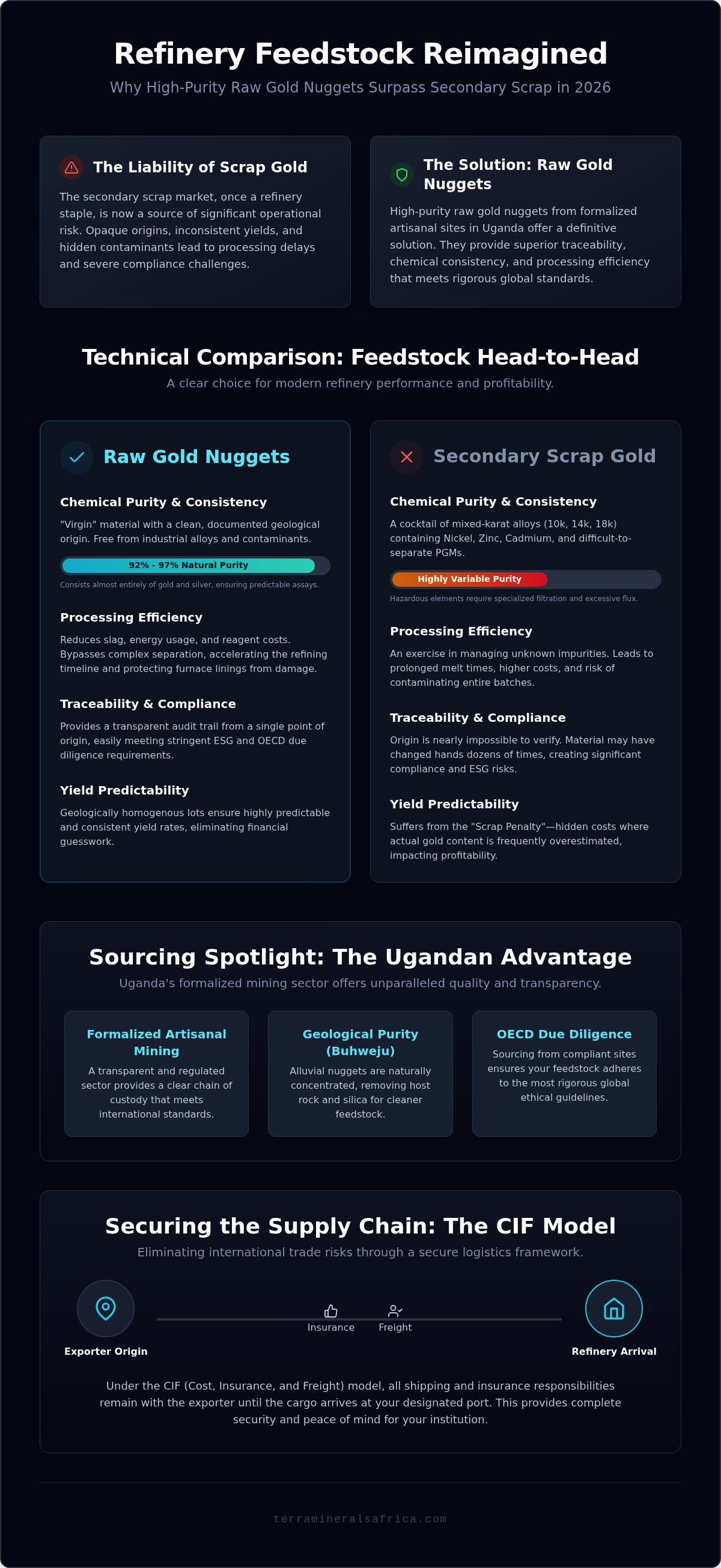
Refineries in 2026 are moving away from the unpredictability of secondary scrap. While recycled gold was once the industry standard, the rise of stringent ESG standards has shifted the focus toward primary materials. Refinery-grade gold nuggets for refineries offer a distinct advantage; they are "virgin" materials with a documented geological origin. Unlike jewelry scrap, these nuggets haven't been alloyed with nickel, zinc, or cadmium. This chemical simplicity is the cornerstone of modern processing efficiency.
It's vital to distinguish between alluvial nuggets and crushed ore concentrates. Alluvial nuggets, like those sourced from the Buhweju region, have been naturally concentrated by environmental forces over millennia. This natural process removes much of the host rock and silica. In contrast, crushed ore concentrates often contain heavy sulfide minerals that complicate the initial melt and damage furnace linings. Choosing alluvial nuggets ensures a cleaner, faster throughput. This efficiency helps refineries maintain their "Good Delivery" status by ensuring the final output is consistently high-grade and free from trace contaminants that are difficult to assay.
Chemical Purity and Processing Efficiency
Refining scrap gold is an exercise in managing impurities. Dental gold and old jewelry often contain hazardous elements that require specialized filtration and excessive flux to neutralize. Raw nuggets from Uganda are different. They typically arrive with a natural purity level between 92% and 97%, consisting almost entirely of gold and silver. This purity reduces the volume of slag produced during the first melt, which saves on energy and reagent costs. By bypassing the complex chemical separation required for contaminated alloys, high-purity raw nuggets accelerate the refining timeline.
The Shift Toward Primary Sourcing in 2026
The global market is increasingly demanding gold with a clean history. Institutional buyers now prioritize "virgin" gold to satisfy strict ESG compliance and OECD due diligence. This shift has placed a spotlight on Uganda's mining industry, which has evolved into a transparent and regulated sector. Primary nuggets simplify the assaying process because they are geologically homogenous. When a refinery receives a bulk lot from a specific region like Buhweju, the yield rates are highly predictable. This predictability is the antidote to the "scrap penalty" often associated with mixed-karat jewelry lots where the actual gold content is frequently overestimated.
Technical Comparison: Raw Nuggets vs. Scrap vs. Refined Bars
Refineries operate on tight margins where feedstock consistency isn't a luxury; it's a requirement. When evaluating gold nuggets for refineries, the primary advantage is homogeneity. Unlike industrial scrap, which is a cocktail of 10k, 14k, and 18k alloys, raw nuggets from a single geological source provide a predictable assay. This stability eliminates the "Scrap Penalty." This penalty encompasses the hidden costs of extra flux, prolonged melt times, and the risk of unexpected base metals that complicate the final pour. By choosing primary nuggets, you're investing in a predictable outcome rather than a variable experiment.
Refined bars represent the peak of purity, yet they carry a significant market premium. For a refinery looking to balance input costs with output quality, raw nuggets offer a strategic middle ground. They provide the "virgin" material status required for Good Delivery bars without the added cost of a third-party refining margin. This allows your facility to capture more of the value chain while maintaining the integrity of your final product. It's a pragmatic choice for operators who value both performance and the bottom line.
Feedstock Homogeneity and Melt Loss
Analyzing variance is key to refinery profitability. Artisanal nuggets from the Buhweju region show remarkably low variance in their silver-to-gold ratio. Industrial scrap, however, often contains platinum group metals (PGMs) used in white gold or industrial coatings. These PGMs are notoriously difficult to separate and can contaminate an entire batch. By using raw nuggets, you've already reduced the risk of PGM contamination and lowered your processing energy requirements. It's a calculated ROI based on cleaner chemistry and fewer technical hurdles.
Traceability and Compliance Audits
Traceability is the industry's new North Star. Nuggets are inherently easier to trace to a single point of origin than scrap material. A lot of jewelry scrap might have changed hands dozens of times over decades, making a clear audit trail nearly impossible. Primary raw materials allow for a clean Chain of Custody that meets LBMA and OECD standards from the moment of extraction. This level of transparency is why many institutions are looking to partner with reliable African exporters who can provide full documentation from the mine site to the refinery door. Clear documentation isn't just a legal requirement; it's the foundation of a secure and permanent supply chain.
Ethical Sourcing and Regulatory Compliance in Uganda
Uganda's gold sector has undergone a radical transformation. The implementation of the Mining and Minerals Act 2022 provided the legislative framework needed to move away from unregulated trade. By November 2025, gold exports reached $5.8 billion, representing over 76% of the country's total export receipts. This growth is built on a foundation of formalization. We take pride in our direct oversight of artisanal mining in Buhweju. It's a commitment to transparency that ensures every lot of gold nuggets for refineries is free from conflict and ethically produced.
Compliance isn't just a hurdle; it's a competitive advantage. We align our operations with the OECD Due Diligence Guidance and the ICGLR Regional Certification Mechanism. This ensures that the human element of mining is protected. The TENT Grant Initiative, which runs through October 2026, is a prime example of how formalizing cooperatives improves local livelihoods. By supporting these structured systems, we provide refineries with the assurance that their feedstock supports community development rather than exploitation. Ethical integrity is now as valuable as the metal itself.
The Buhweju Mining District: A Case Study in Quality
The Buhweju region is renowned for its high-purity alluvial deposits. These nuggets are characterized by low host-rock inclusion and a high gold-to-silver ratio. Our presence at the mine site allows for environmental stewardship that exceeds local requirements. We monitor the supply chain from the initial pit extraction to the final export office. This pit-to-port transparency is essential for modern refineries that must answer to shareholders about their environmental footprint. We ensure that the land is respected and the miners are compensated fairly for their labor.
Compliance Documentation for International Buyers
Securing a legitimate supply requires rigorous documentation. To export gold from Uganda, a company must hold a valid Mineral Dealer's License and an export permit from the Directorate of Geological Survey and Mines (DGSM). We maintain strict Anti-Money Laundering (AML) and Know Your Customer (KYC) protocols to ensure every transaction is beyond reproach. For 2026, international buyers should expect a full documentation package. This includes the Certificate of Origin and tax clearance from the Uganda Revenue Authority. Verifying these licenses is the first step in building a secure, long-term partnership in the East African market. We provide the clarity needed to satisfy both internal audits and international regulators.
Securing the Supply Chain: The CIF Logistics Model
International gold procurement often fails at the logistics stage. High-value cargo requires more than just a standard courier; it requires a complete transfer of risk framework that protects the buyer. This is why we operate exclusively on CIF (Cost, Insurance, Freight) terms. By maintaining responsibility for the material until it reaches your doorstep, we eliminate the primary source of anxiety in the global gold trade. When sourcing gold nuggets for refineries, the logistics must be as reliable as the purity of the metal itself. We take pride in managing the complexities of East African transit so our partners don't have to.
Understanding CIF vs. FOB in Gold Trading
Many exporters prefer FOB (Free on Board) terms because it shifts the burden of risk to the buyer the moment the gold clears the port of origin. We believe this model is fundamentally flawed for high-stakes refining operations. Under FOB, the refinery is responsible for insurance and freight while the goods are still in a foreign jurisdiction. This creates significant supply chain opacity and financial exposure. Our CIF model ensures that insurance premiums and specialized bullion freight are integrated into a single, transparent price. We utilize world-class bullion couriers to manage the transit from Uganda to your facility. This ensures full-value insurance coverage is in place throughout the entire journey. It's a professional standard that prioritizes the security of your capital over our own administrative convenience.
The Inspection and Assaying Process
Trust is built on verification. Before any shipment leaves Uganda, a preliminary assay is conducted to confirm the purity and weight of the lot. This initial documentation provides the baseline for the export permit and insurance valuation. However, the final settlement always rests on the refinery's own assay results. This protocol ensures that you only pay for the exact fine gold content received. If a discrepancy arises between the preliminary and final assays, we utilize independent third-party laboratories to resolve the variance. This methodical approach to quality control is why refineries trust us as a stable partner. If you're ready to secure a transparent pipeline, you can contact our export team to discuss your specific feedstock requirements. From the pits of Buhweju to your refinery's melt room, every step is documented, insured, and secured.
Terra Minerals Africa: Your Partner for Bulk Gold Supply
Terra Minerals Africa stands as a seasoned expert in the East African mineral trade. We bridge the gap between artisanal excellence and global industrial requirements. Our operations are built on a foundation of ethical rigor and logistical sophistication. We don't just export minerals; we manage a secure, end-to-end pipeline that prioritizes the refinery's peace of mind. By specializing in gold nuggets for refineries, we provide a primary feedstock that is superior to the unpredictable secondary markets. It's a partnership model based on transparency and the quiet confidence of an established industry leader.
Our wholesale capabilities are designed for scale and consistency. We offer a diverse inventory of high-purity materials to meet varying industrial needs:
- Raw Gold Nuggets sourced directly from the Buhweju region.
- Refined Gold Bars for institutions requiring immediate liquidity.
- Industrial Gold Dust for specific smelting and processing applications.
We manage the entire CIF logistics chain. This means we handle the insurance, the specialized freight, and the export documentation. You don't have to worry about the complexities of Ugandan customs or international transit risks. We maintain title and responsibility until the material is delivered to your secure facility. This commitment to the CIF model is our antidote to the anxieties often associated with international trade. We believe that a reliable partner should carry the logistical burden so the refinery can focus on production.
A Reliable Pipeline of Buhweju Gold
Stability is the most critical asset in refining. Our direct oversight of mining operations in Buhweju ensures a steady volume of material that meets your purity specifications lot after lot. We are uncompromising on our standards. Every gram of gold we trade is conflict-free and fully traceable. This commitment to transparency extends to our communication. You'll have direct access to our team throughout the procurement process. We provide the documentation you need to satisfy both internal compliance officers and external regulators. Unlike providers who focus on digital assets or jewelry recycling, we offer the raw physical material essential for large-scale refining.
Initiating a Transaction: The Path to Partnership
Establishing a partnership with Terra Minerals Africa is a methodical and secure process. We require all new refinery partners to undergo a thorough KYC (Know Your Customer) and AML (Anti-Money Laundering) review. This protects both parties and ensures the integrity of the supply chain. Once onboarding is complete, we provide customized supply contracts tailored to your specific volume requirements. Quotes are generated based on current market spot prices plus a transparent CIF premium. This ensures you're getting fair market value without hidden logistical costs. We invite you to Secure your refinery supply with Terra Minerals Africa today and experience the reliability of a principled pioneer in African gold.
Securing Your Refinery’s Future with Ethical Ugandan Gold
The transition toward primary sourcing represents a strategic shift for refineries aiming for long-term operational stability. By prioritizing high-purity gold nuggets for refineries, your facility can significantly reduce processing overhead while maintaining a fully OECD compliant supply chain. We've established how the Buhweju mining district offers a superior geological profile and how our exclusive CIF delivery model protects your capital throughout the entire transit process. Ethical integrity and logistical security are the foundations of a modern, resilient procurement strategy.
Reliable partnerships are built on transparency and the quiet confidence of expert oversight. We're committed to bridging the gap between local artisanal excellence and your global industrial requirements. You don't have to navigate the complexities of international trade or supply chain opacity alone. Our team provides the permanence and ethical rigor your institution demands. We take pride in being the principled pioneer that secures your feedstock with unwavering reliability.
Contact our trade desk to discuss your refinery feedstock requirements.
Let's build a secure and transparent pipeline that powers your production for years to come.
Frequently Asked Questions
Why are raw gold nuggets preferred over scrap for industrial refining?
Raw gold nuggets for refineries are preferred because they offer a clean chemical profile without the hazardous alloys found in dental or jewelry scrap. Mixed-karat scrap often contains nickel, cadmium, or zinc, which complicates the melting process and increases reagent costs. Nuggets from a primary geological source ensure a predictable yield. This consistency allows your facility to maintain high throughput and "Good Delivery" standards without the technical hurdles associated with recycled materials.
What purity can I expect from raw gold nuggets sourced from Uganda?
You can typically expect a natural purity level between 92% and 97% for nuggets sourced from the Buhweju region. These alluvial deposits consist almost entirely of gold and silver with minimal host rock inclusion. This high baseline purity reduces the volume of slag produced during the initial melt. It's a significant advantage for industrial clients who require a predictable feedstock to optimize their refining timelines and energy consumption for every batch processed.
How does Terra Minerals Africa ensure that their gold is conflict-free?
We maintain direct oversight of our artisanal mining operations in Buhweju to ensure absolute transparency. Our supply chain adheres to the OECD Due Diligence Guidance and the ICGLR Regional Certification Mechanism. By formalizing local cooperatives and monitoring the process from the pit to the export office, we guarantee a conflict-free product. This ethical rigor protects your brand's reputation and ensures compliance with increasingly strict international ESG requirements and regulatory frameworks for African gold.
Why does the company only sell on CIF terms and not FOB?
We operate exclusively on CIF terms to provide our partners with maximum security and a clear transfer of risk. Under FOB terms, the buyer takes title at the port of origin, assuming liability in a foreign jurisdiction. Our CIF model keeps the responsibility for insurance and freight with us until the material reaches your facility. It's a professional standard designed to eliminate the anxiety and hidden costs often found in international gold trading environments.
What documentation is provided with a bulk shipment of raw gold nuggets?
Every bulk shipment includes a comprehensive documentation package to ensure full regulatory compliance. This includes:
- A valid Mineral Dealer's License
- An export permit from the Directorate of Geological Survey and Mines
- A Certificate of Origin and tax clearance
- Full AML and KYC disclosures
This transparent audit trail is essential for satisfying your internal compliance officers and international customs regulators while maintaining a secure chain of custody.
Can I request a specific assay before the gold leaves Uganda?
Yes, a preliminary assay is conducted in Uganda to establish the weight and purity for insurance and export permits. This initial report provides a baseline for the shipment's valuation. However, the final settlement is always based on the assay results from your own refinery. This protocol ensures you only pay for the verified fine gold content received. We also utilize independent third-party laboratories to resolve any significant discrepancies that might arise during the inspection.
What is the minimum order quantity for wholesale gold nuggets?
We focus on supplying wholesale volumes tailored to the needs of industrial refineries and institutional investors. Our contracts are designed for the bulk procurement of raw gold nuggets for refineries, refined bars, or industrial gold dust. This focus on scale allows us to maintain the logistical efficiency of our CIF model. We recommend contacting our trade desk directly to discuss your specific feedstock requirements and current inventory availability for your processing facility.
How is the final price calculated for a CIF gold shipment?
The final price is calculated based on the current market spot price plus a transparent CIF premium. This premium incorporates the specialized bullion freight and full-value insurance coverage required for secure delivery. The total cost is applied to the net fine gold content determined by the final refinery assay. This method ensures a fair market transaction where all logistical costs are clearly defined and the purity of the material is verified before any final payment.

